In Brazil, allergic Contact Dermatitis is managed by allergy & immunologists. Allergic contact dermatitis is a delayed-type (Type IV) hypersensitivity reaction in which T cells primed against a specific chemical produce an itchy, vesicular rash 24-72 hours after re-exposure. It is the second most common form of contact dermatitis after the irritant subtype and accounts for roughly 20% of all occupational skin disease.

Allergic contact dermatitis (ICD-10: L23) is an eczematous skin reaction caused by a T-cell-mediated, delayed-type (Type IV) hypersensitivity response to a low-molecular-weight chemical that penetrates the stratum corneum and binds skin proteins to form an immunogenic hapten-protein complex. The condition develops in two stages. Sensitization occurs on first prolonged or repeated exposure: Langerhans cells and dermal dendritic cells process the hapten and migrate to regional lymph nodes, where they prime allergen-specific CD8+ and CD4+ effector and memory T cells. The elicitation phase begins on re-exposure — usually 24-72 hours later — when the memory T cells return to the skin, release interferon-γ, IL-17, and IL-4/IL-13, and recruit a cellular infiltrate that produces erythema, edema, papules, and vesicles at the contact site.

The key symptoms of Allergic Contact Dermatitis are: Intense itch over the contact area, typically beginning 24-72 hours after re-exposure to the allergen and peaking at day 3-4 — the cardinal feature distinguishing ACD from immediate contact urticaria., Erythematous papules and tiny clear vesicles that may coalesce into oozing, weeping plaques during the acute phase, often with overlying serous crust., Sharp geographic borders that match the area of allergen contact — a band around the wrist from a watchband, a rectangle on the abdomen from a nickel jeans stud, streaks on the forearm from a plant., Burning, stinging, or pain in heavily inflamed or fissured areas, especially on the hands, eyelids, lips, and perianal skin where the stratum corneum is thin., Lichenification — thickened, leathery skin with exaggerated skin markings — over chronically exposed and scratched sites such as the dorsal hands, eyelids, and feet., Hyperpigmentation or hypopigmentation after inflammation resolves, especially in skin of color, which can persist for months after the active dermatitis has cleared., Spread of the eruption beyond the original contact site over days (id reaction or autoeczematization), producing scattered papulovesicles on the trunk and limbs even where no allergen touched..

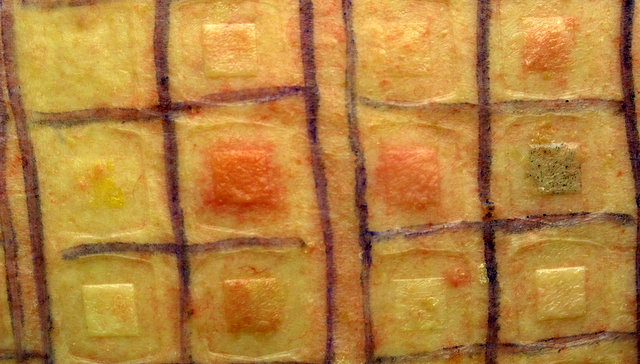
Diagnosis of allergic contact dermatitis begins with a detailed exposure history aligned to the rash pattern: when did it start, what touched the skin, what improves it on weekends or holidays, what at-work versus at-home products are used. The decisive investigation is patch testing — the gold-standard diagnostic recommended by both the American Contact Dermatitis Society and the European Society of Contact Dermatitis. The technique applies standardized allergen-loaded chambers to the upper back for 48 hours, with readings at day 2, day 4 and (where logistics allow) day 7. The North American 80-allergen Core Series and the European Baseline Series each detect 70-80% of clinically relevant allergens; supplemental series (cosmetics, hairdressers, dental, plastics-and-glues, fragrance, plants) are added based on history. A positive reaction grades from doubtful (?+) through 1+ erythema and papules, 2+ vesicles, to 3+ bullous reactions; relevance to the current dermatitis must then be assessed by an experienced reader using the patient's exposures. Histology is not specific but can exclude mimickers in atypical cases — biopsy of acute ACD shows spongiosis and a perivascular lymphocytic infiltrate, similar to atopic dermatitis. Specific IgE and skin-prick tests have no role in classical ACD, since the disease is T-cell mediated rather than IgE mediated; they are reserved for suspected contact urticaria. The decisive differentials to keep in mind are irritant contact dermatitis (non-immunologic, more burning than itching, no sharp borders), atopic dermatitis (flexural, lifelong, atopic stigmata), nummular eczema (coin-shaped, no allergen pattern), seborrheic dermatitis (greasy scale on sebum-rich areas), psoriasis (well-demarcated plaques with silvery scale), and tinea (KOH-positive scale, central clearing). A negative comprehensive patch test in a true ACD-pattern eruption should prompt re-testing with expanded or work-specific series and review of patients' own products before concluding the disease is not allergic.
With confident allergen identification and strict avoidance, the prognosis for allergic contact dermatitis is excellent. Most acute flares resolve within 2-4 weeks once exposure is eliminated and topical anti-inflammatory therapy is started. Long-term clearance depends on how comprehensively the allergen can be removed from daily life — patients with nickel, fragrance, or preservative allergy who substitute products correctly remain clear in 60-80% of cases at 6-12 months. Occupational hand dermatitis is the most prognostically difficult subset: persistent disease occurs in 30-50% even with workplace modifications, and 5-10% of severely affected workers leave their occupation permanently. ACD itself does not shorten life, but chronic disease carries measurable burden — significant impact on work, daily activities, and quality-of-life scores comparable to moderate psoriasis, plus increased rates of anxiety and depression. The decisive prognostic factor is not the initial severity but how well allergen avoidance is sustained over months and years. Sensitization, once established, persists for life; a single re-exposure decades later can reproduce the original dermatitis. Patients who successfully integrate avoidance into daily life typically remain symptom-free indefinitely.
Refer to a dermatologist with patch-testing experience whenever the dermatitis is chronic, recurrent, occupationally disabling, fails first-line topical therapy after 4-6 weeks, or has an unusual distribution that suggests a contact pattern. Allergists are appropriate co-managers when contact urticaria or systemic allergy is also suspected, and occupational physicians should be involved early in work-related cases to address workplace exposures and disability paperwork. Patients with eyelid, facial, perianal, or genital ACD particularly benefit from early specialist input because of the diagnostic complexity and risk of treatment-induced atrophy in these sites.
Find specialists →An acute allergic contact dermatitis flare typically responds within days of allergen removal and topical corticosteroid initiation: visible redness drops within 3-5 days, itch within 5-10 days, and most flares clear within 2-4 weeks. Lichenified chronic plaques take longer — 4-12 weeks of consistent therapy plus avoidance. Post-inflammatory hyperpigmentation can persist for 2-6 months after the active dermatitis resolves, especially in skin of color. After successful patch-testing and confirmed avoidance, most patients see meaningful improvement within 1-3 months, and full re-equilibration of skin barrier and microbiome over 3-6 months. Re-exposure at any point can reproduce the original eruption within 24-72 hours.
Exercise is safe and encouraged. Sweat alone is irritant rather than allergic and rarely flares pure ACD, but wet skin penetrates allergens more efficiently — shower lukewarm within an hour after activity, then apply emollient. Use accelerator-free gloves for sports involving rubber grips, and wash hands after handling gym equipment, weights, and turf. Swimmers with chlorine-related dermatitis should rinse and moisturize immediately on exit.
Look for a board-certified dermatologist who routinely performs patch testing with both the North American Core Series and supplemental series (cosmetics, hairdressers, dental, plastics-and-glues, fragrance, plants). Ask whether the clinic offers ROAT testing for ambiguous reactions and whether the dermatologist provides a written allergen-avoidance plan plus access to a product database such as the ACDS CAMP app. Continuity matters — allergen avoidance is a long-term skill set and a clinician who knows your trigger profile will out-perform episodic specialist visits.
Medically reviewed by AIHealz Medical Editorial Board · May 12, 2026
Ranked by patient outcomes and specialized experience.
Verifying top specialists in Brazil.
Apply as specialist →Specialists who treat Allergic Contact Dermatitis. Get expert guidance and personalized care.