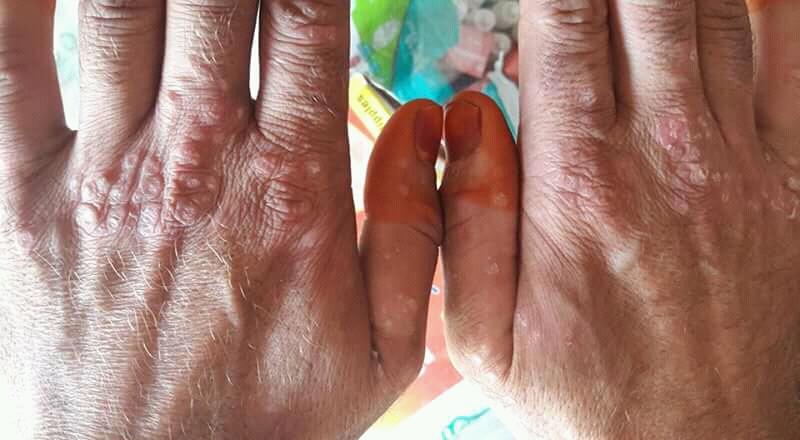
In Russia, psoriasis is managed by dermatologists. Psoriasis is a chronic immune-mediated inflammatory disease in which IL-23 and IL-17 driven activation of T cells accelerates the skin's renewal cycle from roughly 28 days to 3-5 days, producing the characteristic thick, scaly red plaques. It affects about 7.5 million US adults (3% of the population) and roughly 125 million people worldwide, with onset peaks between ages 15-25 and 50-60.

Psoriasis (ICD-10: L40; L40.0 plaque, L40.1 generalized pustular, L40.4 guttate, L40.5 arthropathic, L40.9 unspecified) is a chronic immune-mediated inflammatory disease of the skin and joints driven by the IL-23/Th17 axis. Activated dendritic cells release IL-23, which expands Th17 cells producing IL-17A, IL-17F, IL-22, and TNF-α; these cytokines drive keratinocyte hyperproliferation, abnormal differentiation, and neutrophilic infiltration of the epidermis. The pathognomonic clinical lesion is a well-demarcated, erythematous plaque with silvery-white scale, typically symmetric and favoring extensor surfaces. Disease severity is staged by body surface area involvement and validated indices (PASI for plaque psoriasis, BSA, IGA), with absolute PASI 90 or PASI 100 — 90% or 100% reduction from baseline — now the modern benchmark of effective therapy.

The key symptoms of Psoriasis are: Well-demarcated, raised red plaques covered with thick silvery-white scale, classically on the elbows, knees, scalp, and lower back; lesions are symmetric and persist for months to years., Pinpoint bleeding when scale is scraped off — the Auspitz sign — caused by tortuous dilated capillaries in the dermal papillae just beneath the thinned epidermis., Itching of moderate intensity in roughly 70-90% of patients; less prominent than in eczema but often interferes with sleep., Burning, stinging, or soreness within active plaques, especially in flexural psoriasis or sensitive sites like the genitals., Cracking of plaque skin with painful fissures, particularly over the knuckles, palms, and soles; bleeding fissures are common in palmoplantar disease., Nail changes including pitting (small depressions in the nail plate), onycholysis (lifting of the nail), oil-drop spots, and subungual hyperkeratosis — present in 50% of patients., Scalp involvement with thick, scaly plaques that extend beyond the hairline onto the forehead, retroauricular skin, and posterior neck; temporary diffuse hair shedding can occur..

Psoriasis is a clinical diagnosis. Most cases are recognized on a bedside examination of well-demarcated erythematous plaques with silvery scale over typical extensor surfaces, scalp, umbilicus, and intergluteal cleft. The Auspitz sign (pinpoint bleeding after scale removal) and Koebner phenomenon (new lesions at sites of trauma) further support the diagnosis. The exam should always include the scalp, nails (pitting, onycholysis, oil-drop sign), gluteal cleft, umbilicus, and palms and soles — sites patients often do not show. Skin biopsy is reserved for atypical presentations or when distinguishing psoriasis from mycosis fungoides, subacute cutaneous lupus, or pityriasis rubra pilaris. Histology shows parakeratosis, neutrophilic Munro microabscesses, elongated rete ridges, and capillary dilation in the dermal papillae. Severity is assessed by body surface area, Psoriasis Area and Severity Index (PASI), Investigator Global Assessment (IGA), and quality-of-life metrics such as the Dermatology Life Quality Index (DLQI). Joint assessment is mandatory because 30% of patients develop psoriatic arthritis; the PsA Screening and Evaluation (PASE) and PEST questionnaires identify at-risk patients for rheumatology referral. Baseline labs include CBC, comprehensive metabolic panel, fasting lipid panel, hepatitis B/C screening, tuberculosis testing (PPD or interferon-gamma release assay), and pregnancy testing in women of reproductive age prior to systemic therapy. Cardiometabolic screening — blood pressure, fasting glucose, lipid panel — is recommended at diagnosis given the established cardiovascular risk.
Psoriasis is a chronic relapsing disease without a definitive cure, but modern therapy has transformed outcomes. With biologic therapy, 60-85% of moderate-to-severe patients now achieve PASI 90 (90% improvement) within 16 weeks, and roughly 40-60% achieve complete skin clearance (PASI 100) with the newest IL-17A/F and IL-23 inhibitors. Remission durations of 6-12 months between courses are common with phototherapy alone, and continuous biologic therapy can maintain near-clearance indefinitely in responders. Psoriatic arthritis develops in ~30% of skin-disease patients, typically 5-10 years after skin onset, and early treatment with disease-modifying therapy can prevent joint erosions; nonetheless, untreated PsA can produce permanent joint damage in 40-60% of patients. Cardiovascular mortality is elevated by roughly 50-70% in severe psoriasis; aggressive treatment of skin disease and cardiometabolic risk factors narrows this gap. Mental-health comorbidity is substantial — depression affects up to 25% and the suicide risk is roughly 1.5-2× the general population — and integrated care that addresses mood and stress materially improves outcomes.
Refer to a dermatologist for any new suspected psoriasis diagnosis, for plaque psoriasis involving more than 3-5% body surface area, for involvement of the scalp, face, palms, soles, nails, or genitals, for failure of over-the-counter or first-line prescription topicals after 4 weeks, and for any pustular or erythrodermic presentation (urgent). Refer to a rheumatologist for joint pain, dactylitis, enthesitis, or morning stiffness lasting more than 30 minutes in a patient with skin psoriasis.
Find specialists →Topical regimens for mild-to-moderate plaque psoriasis typically begin to soften plaques within 2-3 weeks and reach maximum effect by 6-8 weeks. Phototherapy schedules over 8-12 weeks induce remission in most responders, often lasting 3-6 months. Methotrexate and apremilast reach peak effect at 12-16 weeks. Biologics show first improvements within 2-4 weeks; peak skin clearance with IL-17A/F and IL-23 inhibitors typically occurs by week 16, with maintenance dosing continued indefinitely while response persists.
Aim for 150 minutes of moderate-intensity aerobic activity per week plus two resistance sessions, the standard adult recommendation. Exercise helps with weight management and reduces systemic inflammation. Avoid tight-fitting workout clothes and shower promptly afterward to reduce sweat-induced irritation in flexural plaques. Public-pool swimming can flare disease for some patients due to chlorine; saltwater swimming is generally well tolerated.
Choose a board-certified dermatologist comfortable with phototherapy, systemic agents, and the full biologic armamentarium. For complex or treatment-resistant disease, seek a dermatologist affiliated with an academic medical center or designated psoriasis center of excellence (NPF-recognized centers in the US). For psoriatic arthritis, a rheumatologist with expertise in spondyloarthropathies is preferred; integrated psoriasis-PsA clinics deliver the best outcomes.
Medically reviewed by AIHealz Medical Editorial Board · May 12, 2026
Ranked by patient outcomes and specialized experience.
Verifying top specialists in Russia.
Apply as specialist →Specialists who treat Psoriasis. Get expert guidance and personalized care.